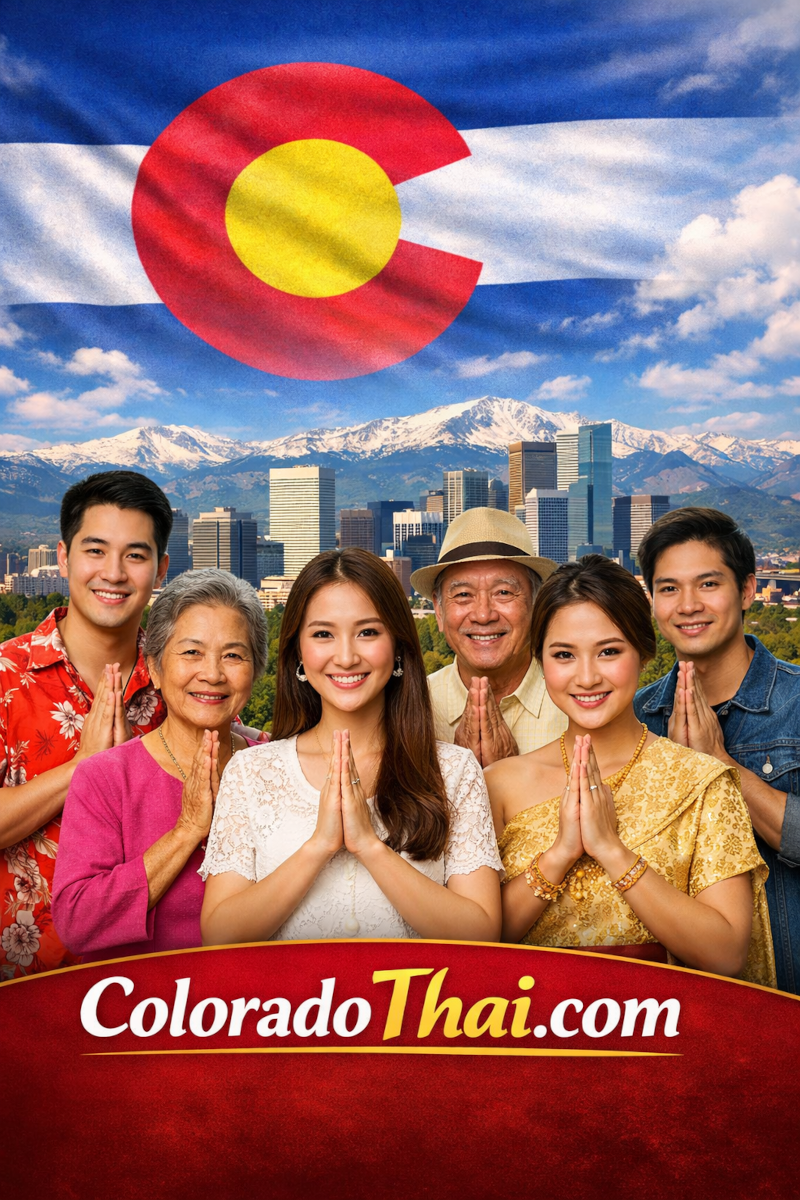
A blossoming Thai American community
As Colorado’s population continues to grow—now exceeding 6 million residents—the state has seen a steady rise in newcomers from across the United States and abroad, contributing to increasingly diverse and multicultural communities throughout the Rocky Mountain region. Within this broader demographic shift, the Thai and Thai American community is also experiencing remarkable growth, establishing a visible and active presence across the state.
The Centennial state’s Thai and Thai American community has become a visible, steadily growing part of the state’s broader Asian-American tapestry—most notably along the Front Range from Fort Collins and Boulder, through the greater Denver metropolitan area and and down through to Colorado Springs.
It is difficult to put an accurate number on how many Thais and Thai Americans presently reside in Colorado. According to one snapshot from the Colorado Lotus Project (drawing on the U.S. Census Bureau’s American Community Survey 5-year estimates) in 2021 there were about 6,061 people in Colorado identify as Thai (including people with multiple Asian American and Native Hawaiian and Other Pacific Islander identities);
This number likely increased during the post-Covid years. judging from the increased number of Thai restaurants, food trucks and businesses in general.
Thai American community life often centers around Thai Buddhist institutions that double as cultural hubs—hosting merit-making events, holiday celebrations (Songkran, Visakha Puja, Kathina), Thai language and cultural learning, and informal mutual support networks for newcomers.
In the Denver metro area, a key anchor is Wat Buddhawararam of Denver (often referred to locally as a Thai temple in Denver), which lists its Denver-area address and public-facing programming on its official site. In the Colorado Springs region, Wat Santidhamma of Colorado Springs (located in Peyton/Falcon area) is widely referenced as a Thai Theravada temple established in the mid-1990s and serving both Thai and non-Thai visitors. In addition, community listings frequently reference Wat Buddhapunyaram (Tai Lü Buddhist Temple) in Brighton as part of Colorado’s Buddhist/Thai-linked religious landscape.
Food is another major “public face” of the community. While an exact statewide count changes constantly (openings/closures, duplicates, and category labeling), Google/consumer dining directories consistently show a large number of Thai restaurants spread across Colorado, with the greatest concentration in the Denver metro and additional clusters in major towns and tourist corridors. Even city-level listings (for example, travel/dining directories that track cuisine by location) illustrate how broadly Thai dining has penetrated beyond Denver into smaller markets. (Tripadvisor)
Taken together, the data and institutions point to a community that is both numerically meaningful and organizationally rooted—with temples, restaurants, and cultural activity reinforcing visibility and continuity as Colorado continues to diversify.
Top Categories
Anthuriums
Cactus

Sunflowers